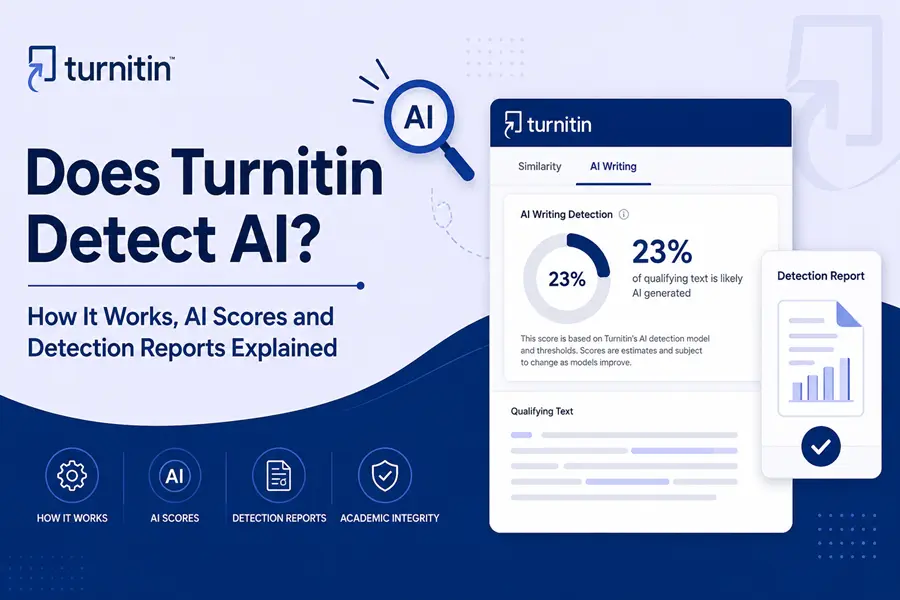
Yes, Turnitin detects AI-generated text. It has been able to do this since April 2023. Today in 2026, it uses three separate detection models working together. These models check if text was written by AI, rewritten by a paraphrasing tool, or passed through an AI humanizer. The result appears as a percentage inside the same report instructors already use for plagiarism checking.
This guide by web design los angels team explains how the detection system works, what the AI score means, who can see it, how accurate it is, and where it falls short. All facts below are based on verified 2025 and 2026 data.
What Is Turnitin AI Detection?
Turnitin is used by more than 16,000 universities and schools across 185 countries. It has handled plagiarism detection for over two decades. AI writing detection is a newer feature built on top of that same system.
Here is the key difference between the two:
- Plagiarism detection compares your text against a database of known sources and flags copied content.
- AI detection does not use any database. It reads the writing patterns in your text and calculates how likely it is that an AI model wrote it.
These two scores are completely separate. A student can score 0% for plagiarism and still get a high AI writing percentage. They measure completely different things.
| Real-Life Example: The Content Team Submission
A content manager at a digital marketing agency submits blog drafts from three writers for a client review. One writer, instead of researching and writing the 1,200-word article, generates it directly in ChatGPT and submits it as their own work. When the agency uses Turnitin to check submissions, that draft scores 87% AI-generated. The other two writers score 0% and 4%. The content manager can now see exactly which paragraphs were flagged and has a clear reason to speak with that writer before the draft goes to the client. |
How Turnitin AI Detection Works in 2026
Turnitin follows a clear step-by-step process every time a paper is submitted. Here is exactly what happens:
Step 1: Qualify the Submission
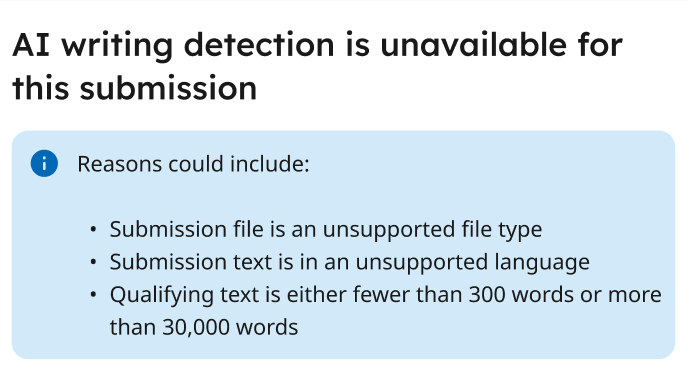
Before anything is analyzed, Turnitin checks if the paper qualifies. To be scored for AI, the submission must:
- Be at least 300 words long
- Contain proper prose sentences, like an essay, report, or article
- Be submitted in a supported language (English, Spanish, or Japanese)
Lists, bullet points, code, and very short assignments are not analyzed. If the paper does not qualify, no AI score is generated.
Step 2: Split Into Segments
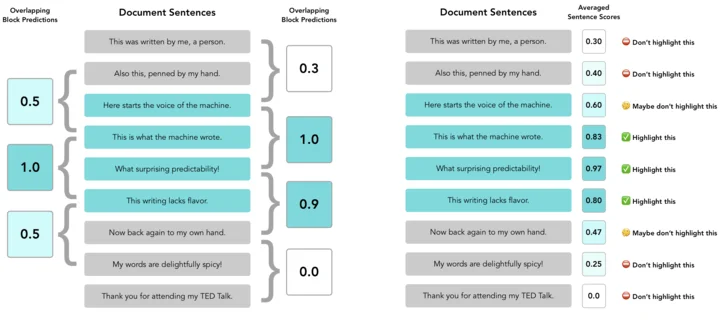
Once a paper qualifies, Turnitin breaks the text into overlapping blocks of about 250 words each. That is roughly five to ten sentences per block. The blocks overlap on purpose so every sentence is read in the context of the sentences around it, not in isolation.
Step 3: Score Every Sentence
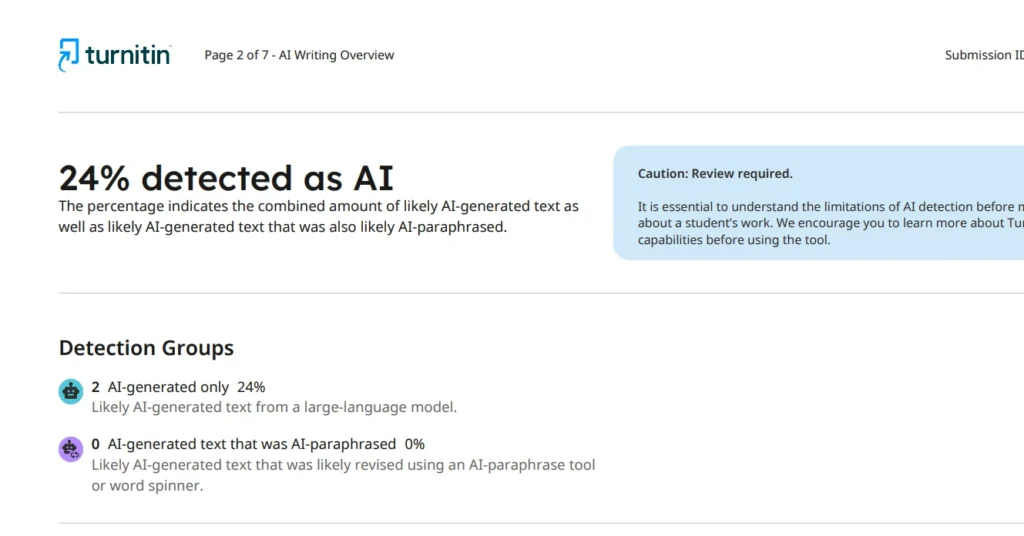
Each block is run through three AI detection models at the same time. Every individual sentence receives a score between 0 and 1:
- Score of 0 means the sentence looks human-written
- Score of 1 means the model is highly confident the sentence was written by AI
These sentence-level scores are combined to create one overall AI writing percentage for the full document.
Step 4: Generate the Report
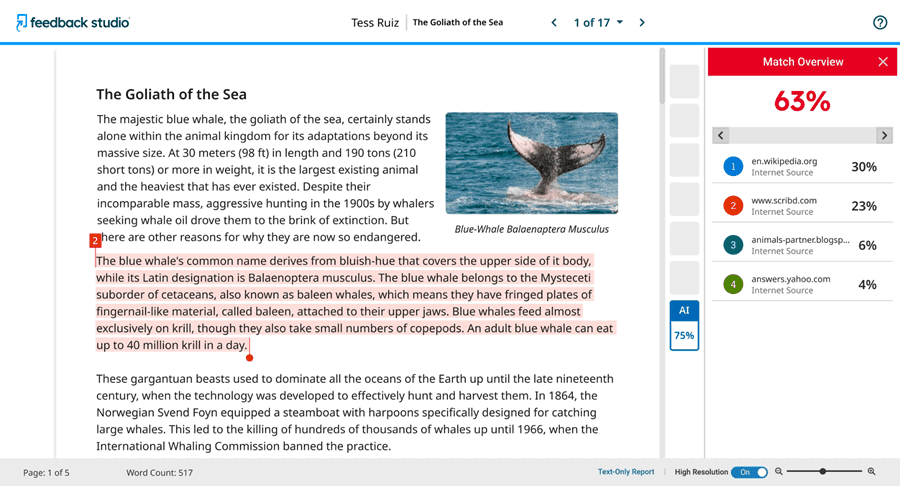
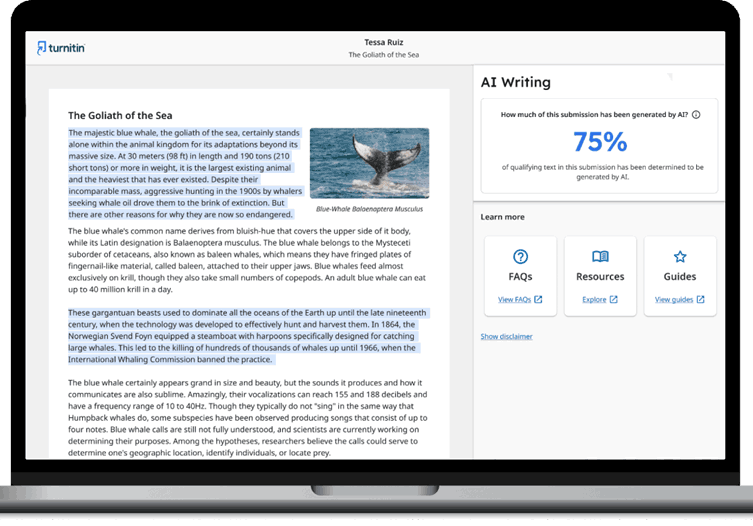
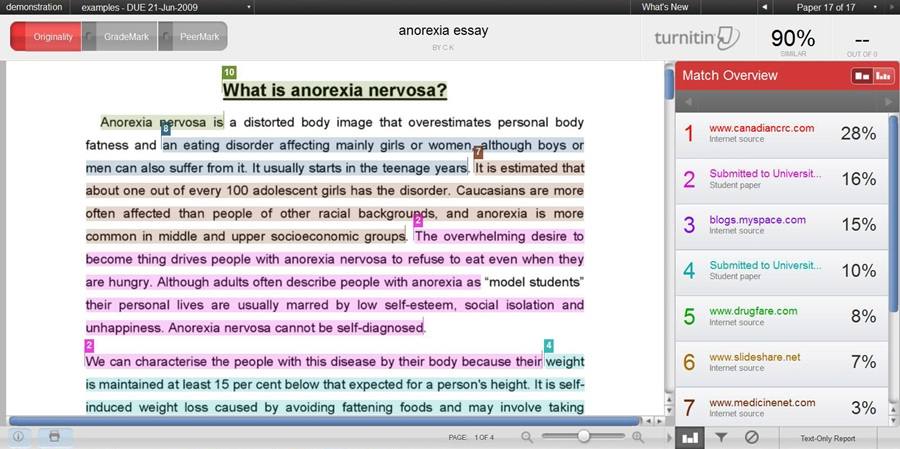
The final AI writing percentage and a color-highlighted version of the paper appear in the Similarity Report. Instructors can see exactly which sentences were flagged and what type of AI use was detected.
| Real-Life Example: The Short Article That Flew Under the Radar
A content writer is asked to produce a 250-word product description. She uses ChatGPT to write the full draft and submits it. Turnitin does not flag it because the submission is below the 300-word minimum required for AI analysis. This is a known limitation. Very short content pieces, social media captions, taglines, and brief descriptions fall outside what the detection system can reliably analyze. |
The Three Detection Models Explained
Since August 2025, Turnitin runs three models on every qualifying English submission at the same time. Here is what each one does:
Model 1: Direct AI Writing
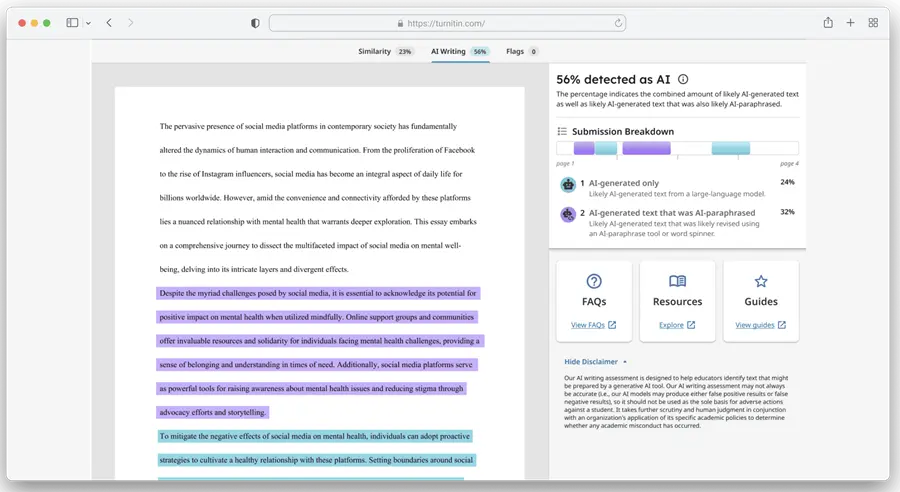
This is the core detection model. It identifies text written directly by a large language model like ChatGPT, Google Gemini, or Claude, without any editing after generation. It was first launched in April 2023 and has been updated to detect GPT-4, GPT-4o, GPT-5, Gemini 2.5 Pro and Flash, Claude Sonnet, LLaMA, and other major models.
| Real-Life Example: The Unedited Blog Post
A junior content writer at an SEO agency copies a 900-word blog article directly from ChatGPT and submits it to the team lead without changing a single word. The submission scores 91% AI-generated. The highlighted report shows nearly the entire article in cyan, meaning the system is highly confident the text came from a language model. The team lead sees this in the report before the article goes live on the client website. |
Model 2: AI Paraphrase Detection
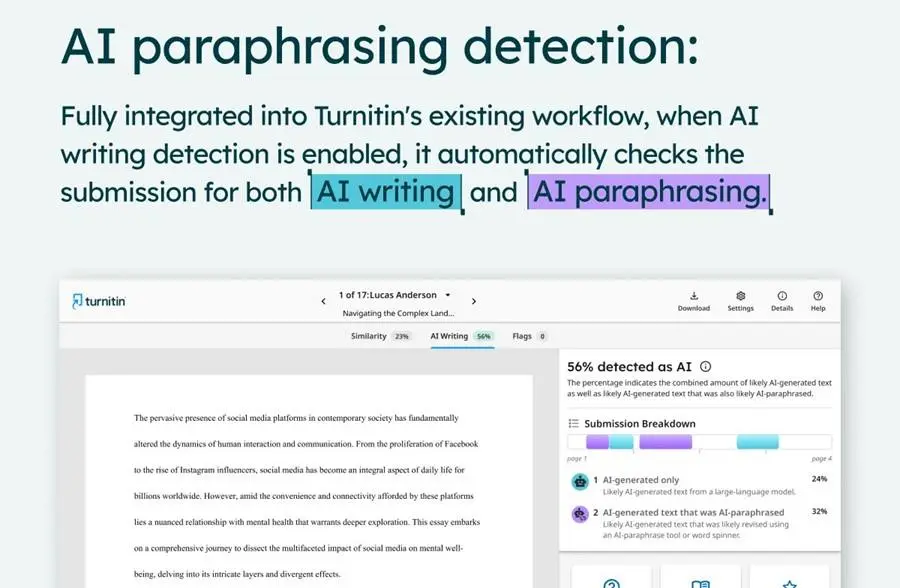
This model catches text that started as AI output and was then run through a paraphrasing tool like Quillbot to sound more human. Turnitin added this model in July 2024 specifically to target this behavior. Text flagged by this model is highlighted in purple in the report.
| Real-Life Example: The Quillbot Workaround That Stopped Working
A content writer generates a 700-word article in ChatGPT, then pastes it into Quillbot and runs the paraphrase function before submitting. Before July 2024, this method often reduced the AI score. After Turnitin’s paraphrase detection model launched, the same submission now shows 68% AI-generated with purple highlights across the paraphrased sections. The paraphrasing changed individual words and sentence order, but the statistical fingerprint of AI-generated structure remained visible to the detection model. |
Model 3: AI Bypasser Detection
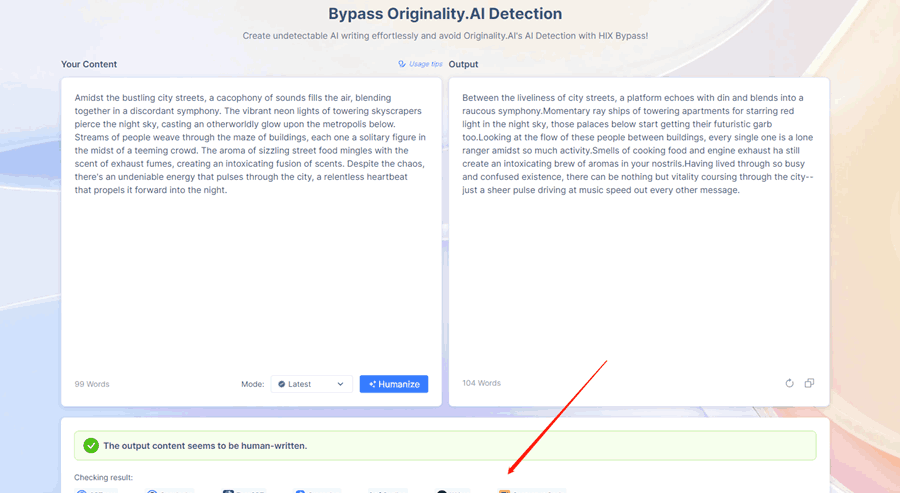
This is the newest model, added in August 2025. It targets AI humanizer and bypasser tools, which are software products designed to rewrite AI content so it passes detection systems entirely. After this update, many humanizer tools that worked in early 2025 stopped being effective against Turnitin.
| Real-Life Example: The Humanizer That No Longer Works
A content writer runs a ChatGPT draft through a popular AI humanizer tool, confident that it will pass detection. Before August 2025, this approach reduced Turnitin scores significantly. After Turnitin’s bypasser detection model launched, the same process now returns a flagged score. The new model was specifically trained on the output patterns of these humanizer tools. Writers who relied on this method throughout 2025 began reporting that submissions that previously scored 0% started returning scores of 40% to 60% after the August 2025 update. |
The Technology Behind It: Perplexity, Burstiness, and Deep Learning
Turnitin uses a transformer-based deep learning model, the same type of architecture used by ChatGPT and other AI tools.
Perplexity: How Predictable Is the Text?
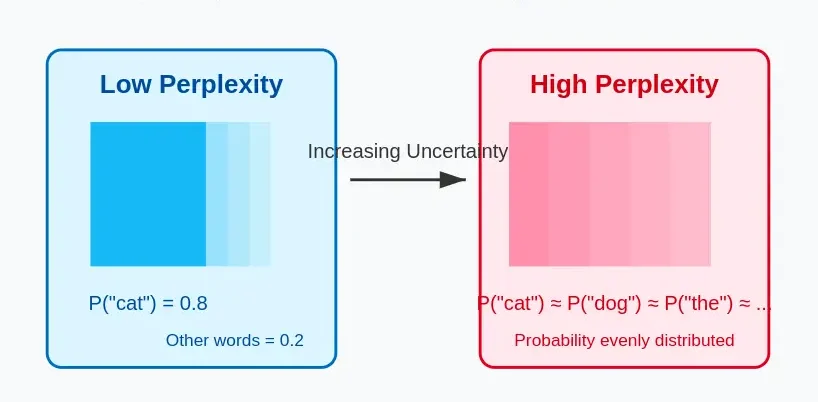
Perplexity measures how predictable a sequence of words is. AI models always choose the most statistically likely next word, making AI writing very predictable.
- Low perplexity = likely AI-written (highly predictable word choices)
- High perplexity = likely human-written (unexpected, varied word choices)
Burstiness: How Varied Are the Sentences?
Burstiness measures how much sentence length varies throughout a document.
- Humans naturally mix short punchy sentences with long complex ones
- AI writing tends to keep a consistent rhythm and similar sentence lengths throughout
- Low burstiness is a strong signal the text may be AI-generated
Beyond Perplexity and Burstiness
Turnitin’s transformer model also analyzes:
- Vocabulary richness and word choice patterns
- How function words like ‘the’, ‘and’, ‘of’ are distributed
- Punctuation habits and frequency
- Complex sentence structure features that simpler tools cannot detect
| Real-Life Example: Why Perplexity Matters in Content Writing
A content writer is asked to write a product review. An AI-generated version of the review uses smooth, even sentences with predictable transitions like ‘Additionally,’ ‘Furthermore,’ and ‘In conclusion.’ Every sentence flows at a similar length and pace. A human-written version of the same review includes a short reaction (‘I was genuinely impressed.’), followed by a longer explanation with a personal anecdote, then a quick summary line. This natural variation in rhythm and word choice registers as high perplexity and high burstiness, both signs of human writing. |
Understanding the AI Writing Score
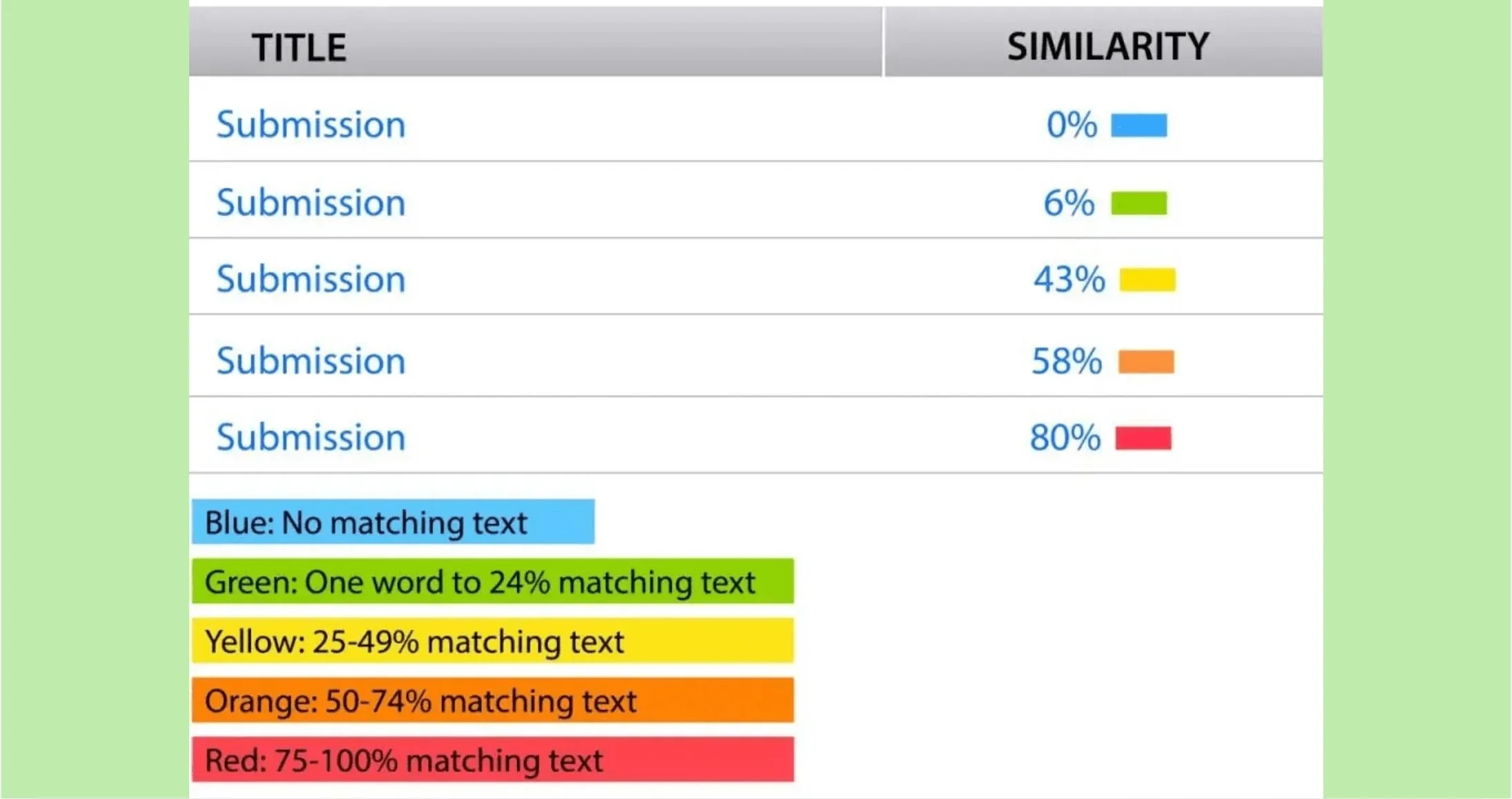
The score is displayed as a percentage inside the Similarity Report. It represents how much of the submitted text appears to have been written by AI.
Score Ranges and What They Mean
- 0% No AI patterns found. Does not guarantee the work is original.
- *% (Asterisk) Score is between 1% and 19%. Some AI-like patterns detected but result is too uncertain to show as a number. Introduced July 2024.
- 20% to 40% A small portion looks like AI writing. Could be genuine AI use, formulaic style, or a false positive.
- 40% to 70% A significant portion appears machine-generated. Investigate further.
- 80% and above Most of the detectable text appears to have been written by AI.
Color Highlights in the Report
- Cyan highlighting Text that appears to have been written directly by an AI model
- Purple highlighting Text that appears to have been AI-written and then paraphrased
| Real-Life Example: Reading the Score in a Content Office
A content manager reviews three submitted articles. Article A scores 0%, Article B shows an asterisk (*%), and Article C scores 74%. Article A is cleared and sent to the client. Article B is reviewed carefully because the asterisk means some AI-like signals exist but are not strong enough to confirm. Article C is flagged for a conversation with the writer before it moves forward. The manager does not reject Article C outright based on the score alone, but asks the writer to walk through their research and drafting process. |
Who Can See the AI Detection Report?
- Instructors / Team Leads: Can see the full AI writing report inside the Similarity Report
- Administrators: Can see aggregated AI writing data across the whole institution or team
- Investigators: Can see AI writing scores in the Authorship Report alongside similarity data
- Students / Writers: Cannot see the AI score at all
The AI report can also be downloaded as a PDF. Access requires a Turnitin Originality license.
How Accurate Is Turnitin AI Detection in 2026?
Turnitin’s Official Claims
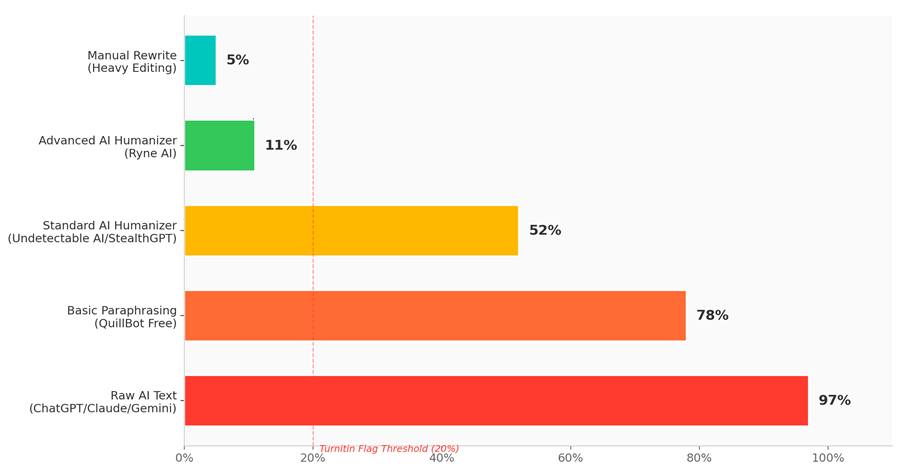
- 98% accuracy for detecting AI-generated content
- False positive rate below 1% for documents with 20% or more AI content
- Intentionally misses about 15% of AI content to keep false positives low
Independent Testing Results (2025-2026)
- ChatGPT-4o: 96% detection rate on unedited output
- Claude: 92% detection rate on unedited output
- Google Gemini: 91% detection rate on unedited output
Where Accuracy Drops
- Edited AI drafts: Detection drops to 60% to 85% after moderate human editing
- Heavily rewritten content: Detection can fall below 50% after significant restructuring
- Short submissions: Papers under 300 words produce unreliable scores
- Formulaic writing: Templated formats can trigger false flags
False Positives: When Human Writing Gets Flagged as AI
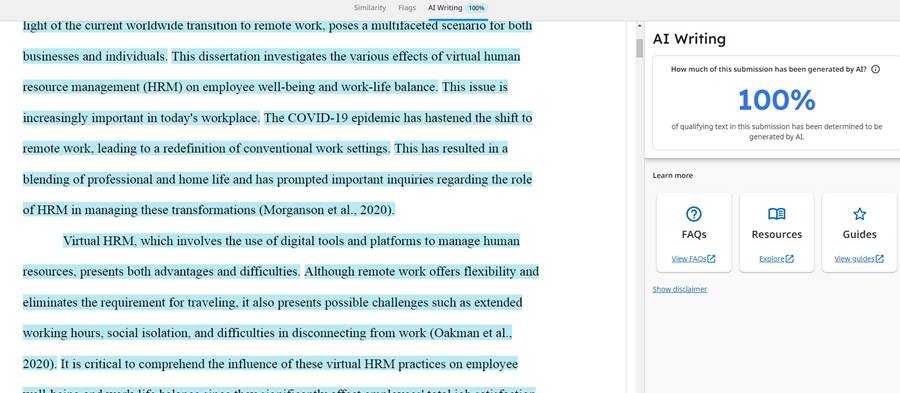
A false positive is when Turnitin marks human-written text as likely AI-generated. This can have real consequences for a writer who did nothing wrong.
Common Causes of False Positives
- Formulaic writing genres: Product descriptions, standard reports, and templated formats use predictable language by design. The model can misread this as AI.
- Non-native English speakers: Writers using simpler vocabulary and repetitive structures due to language proficiency can be flagged incorrectly.
- Highly consistent writing style: Some writers naturally maintain a steady, even tone throughout their work. This can lower burstiness scores and trigger a flag.
| Real-Life Example: The False Positive in a Product Description
A content writer with strong technical writing skills submits a series of 500-word product descriptions for an e-commerce client. Every description follows the same structure: a headline, three feature paragraphs, and a call to action. The language is clear, consistent, and professional. Turnitin returns a score of 34% AI-generated on two of the descriptions. The writer produced both entirely by hand, but the consistent structure and predictable phrasing pattern lowered the burstiness score enough to trigger a partial flag. This is a false positive caused by the formulaic nature of product description writing, not actual AI use. |
What Turnitin Can and Cannot Catch
Turnitin Catches This Well
- Long articles written directly by ChatGPT, Gemini, or Claude without editing
- AI text run through basic paraphrasers without significant restructuring
- AI text that has only been lightly edited at the surface level
- Large sections of AI text mixed into otherwise human-written content
Turnitin Struggles With This
- Content under 300 words, results are unreliable
- AI text that has been substantially rewritten and restructured by a human
- Hybrid content where AI was used for only one or two paragraphs
- Formulaic writing genres that naturally resemble AI writing patterns
- Content from non-native English writers using simple sentence structures
| Real-Life Example: The Heavy Edit That Passed Detection
A content writer uses ChatGPT to generate a rough 800-word draft on a topic they know well. They then spend 45 minutes rewriting every paragraph, adding industry-specific examples, changing the structure, and inserting their own analysis and opinions. The final submission scores 8%, which shows as an asterisk in the report. The extensive human rewriting changed enough of the statistical patterns that the detection model could not confidently identify the original AI source. This illustrates that Turnitin measures the patterns in the final text, not the process that produced it. |
Common Myths About Turnitin AI Detection
Myth 1: A High Score Proves AI Was Used
Fact: The score is a probability estimate, not proof. It is a signal to investigate, not a verdict. Formulaic writing and consistent style can also produce high scores.
Myth 2: Turnitin Catches All AI Use
Fact: It intentionally misses around 15% of AI content to keep false positives low. Edited drafts and short content can score 0% even when AI was involved in drafting.
Myth 3: Zero Percent Means No AI Was Used
Fact: It means the detection model found no clear AI patterns in the final submitted text. A heavily rewritten AI draft can still score 0%.
Myth 4: AI Score and Similarity Score Are Connected
Fact: These are completely separate systems measuring completely different things. They do not affect each other at all.
2026 Update: What Is New With Turnitin
February 2026 Model Update
- Improved recall: the system now catches more AI-generated content than before
- Maintained low false positive rate while improving detection coverage
- Improved Spanish language AI detection model
- AI writing scores now visible inside the Authorship Report used by investigators
February 2026 Data: The Numbers
- 8% of English language essay submissions between October 2025 and February 2026 contained 80% or more AI-generated writing
- 3% was the average at launch in April 2023
This is a nearly fivefold increase in three years, showing how deeply AI writing tools have entered content and academic workflows.
Turnitin Clarity: Process-Based Detection
Turnitin Clarity tracks how content is written from start to finish, capturing draft history, edits, and AI assistant usage. This gives reviewers evidence about the writing process, not just the final output.
- Tracks draft history and editing timeline
- Monitors AI assistant usage inside the writing environment
- Checks for copy-paste activity from external sources
- Gives a full picture of how the content was produced
What Should a Content Team Do With an AI Flag?
An AI score is a signal to investigate, not a reason to reject work immediately. Good practice in a content office means combining the score with other information:
- Ask the writer to share their research notes and draft versions
- Compare the flagged piece with the writer’s previous approved work
- Check if the writing style matches the writer’s known voice and pace
- Have a direct conversation before drawing any conclusions
- Consider the type of content, since formulaic formats naturally score higher
| Real-Life Example: The Fair Review Process
A content editor receives an article with a 61% AI score. Before taking any action, she checks the writer’s previous five submissions, all of which scored 0% to 5%. She reviews the highlighted sentences and notices most flags are on the introductory paragraph, which follows a very generic structure. She asks the writer to show their research notes and an earlier draft. The writer shares a Google Doc with full version history showing they wrote and revised the article over two sessions. The editor decides the flag was likely caused by the generic intro paragraph and asks the writer to rewrite that section in a more personal voice. The issue is resolved without any formal action. |
Quick Summary: Everything You Need to Know
- Turnitin detects AI since April 2023 and now uses three models covering direct AI output, paraphrased AI content, and humanized AI content.
- Detection uses deep learning to analyze perplexity, burstiness, vocabulary, and sentence structure patterns.
- The AI score is a percentage shown only to instructors and reviewers. Scores below 20% show as an asterisk.
- 2026 data shows 8% of English essay submissions between October 2025 and February 2026 contained 80%+ AI content, up from 3% at launch.
- Accuracy is strong but not perfect: 96% on unedited ChatGPT-4o, but drops on edited drafts and short content.
- False positives are real: Formulaic writing, consistent style, and non-native English can all trigger incorrect flags.
- The score is never a verdict: Always combine it with context, writer history, and a direct conversation before drawing conclusions.